Formula 1 in Japan
Japan & Formula 1: when travel is speed
There are destinations where sport transcends mere competition to become a key to understanding the country. Japan has made a significant contribution to the development of all motorsports, and Formula 1 is no exception.
More than just a sporting event, the Japanese Grand Prix is an immersion into a culture where precision, mastery, and a dedication to performance are elevated to an art form. Every autumn, in the heart of Mie Prefecture, tens of thousands of enthusiasts converge on Suzuka. They don't come to watch just any race, but for a motorsport experience unlike any other in the world.
Suzuka, a unique place on the map of Japan
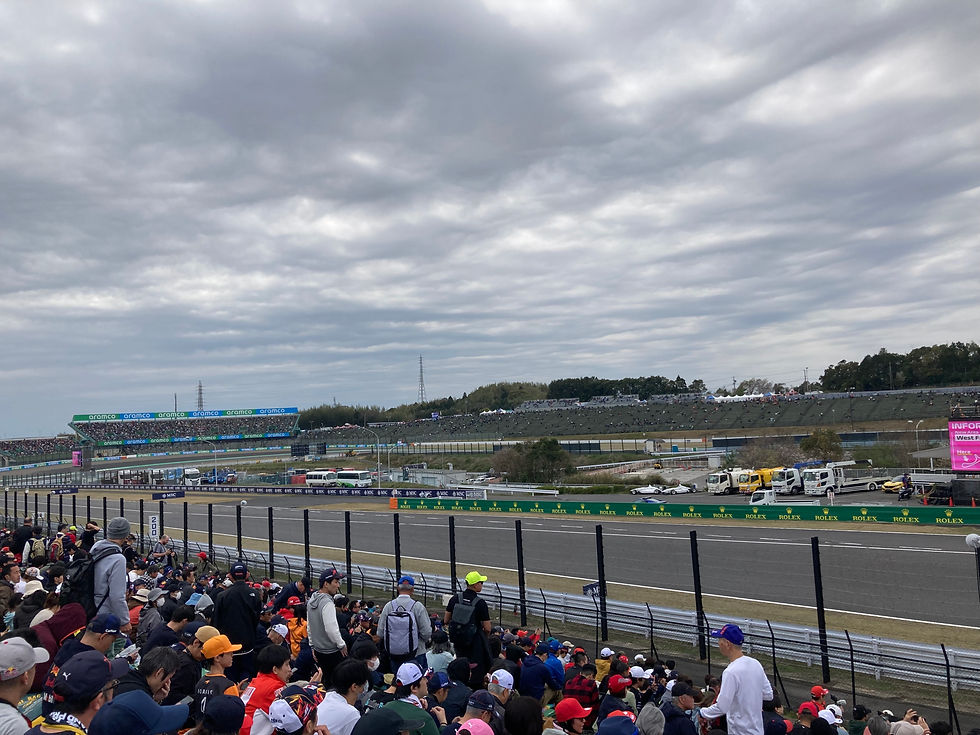
At first glance, Suzuka is anything but glamorous. No Mediterranean port, no skyscrapers, no palm trees. And yet, few motorsport venues can so profoundly capture the imagination. Nestled in a peaceful landscape, the circuit stands in stark contrast to the hustle and bustle of Japan's major cities. You arrive by train, as everywhere in Japan, with an almost choreographed fluidity. Surrounding it are unassuming small towns, a well-kept countryside, and a surprising silence… until the engines roar to life.
Suzuka is more than just a racetrack: it's an almost sacred place for motorsport fans. Here, people walk slowly, observe, and take photos. Fans wear meticulously prepared outfits, often hand-sewn, paying homage to their favorite driver or team.
A track that doesn't cheat
What makes Suzuka so famous is its difficulty. Unlike many modern circuits, it doesn't try to impress with its infrastructure but with its layout. It adopts an unusual figure-eight shape, reminiscent of the toy car tracks of our childhood. Furthermore, the bridge spanning the track is also a rarity that intrigues from the very first visit.
But Suzuka's true uniqueness is felt on the track. The famous sequence of corners in the first sector demands absolute concentration. The turns come one after another without pause, forcing the driver to anticipate every move. Here, there are no shortcuts: the car and the driver are exposed as they truly are. Mythical corners like 130R, taken at very high speeds, perfectly symbolize this philosophy. At Suzuka, the slightest mistake is punished. For a visitor, understanding this is also understanding why so many champions say that "being fast here" is the ultimate form of recognition.
Japan, an invisible but central player in F1
Attending the Japanese Grand Prix also means recognizing the country's fundamental role in Formula 1's technological history. Honda, of course, is its most visible embodiment. The Japanese engine manufacturer has been a part of some of the championship's most legendary periods, from the Senna-Prost era to Red Bull's recent successes. But this presence goes beyond engines. It's felt in the way they work, in their attention to detail, in their quest for absolute reliability. These are values omnipresent in Japanese industry, and naturally, they are also found in F1.
For the curious traveler, this adds an extra dimension to the visit: the race becomes a window onto the country's industrial and technological culture.
A silent but intense passion
The Japanese relationship with Formula 1 contrasts sharply with that observed in Europe. Here, there are no boisterous excesses. The fervor is profound, respectful, almost meditative. The public understands the discipline, follows the technical performances, applauds skill as much as victory, but can also be surprisingly boisterous, much to the drivers' delight. This attitude is part of a broader passion for motorsports: Super GT, Super Formula, endurance racing, and motorcycle racing are all part of the national sporting landscape. Formula 1 simply represents its pinnacle.
For a foreign visitor, this is a rare opportunity to witness a major event without aggression, in a surprisingly serene atmosphere, where there is a collective sense of respect for the pilot, the venue and other spectators.
Japan versus other mythical F1 homelands
Each country with a rich history in Formula 1 tells a different story. Italy is the land of emotion and Ferrari. Great Britain is the land of engineers and paddocks. Monaco is a backdrop. Spa is a landscape. Japan, however, is a challenge. Suzuka isn't just something to be admired; it must be earned. This is what makes it so unique on the F1 world map, and so fascinating to discover as part of a trip.
A unique experience
Attending the Japanese Grand Prix is more than just watching a race. It's about integrating Formula 1 into a larger itinerary: exploring Kansai, discovering Nagoya, immersing yourself in the local culture, savoring understated yet refined cuisine, and experiencing a sporting event in a truly authentic setting. Japan isn't just a stop on the championship circuit. It's a Formula 1 destination in its own right—and one of the most memorable you can add to your travel itinerary.


Comments